

From Francia to China, ‘Do What You Want With Your Slave’
- 10 December 2025
- 0 Comment
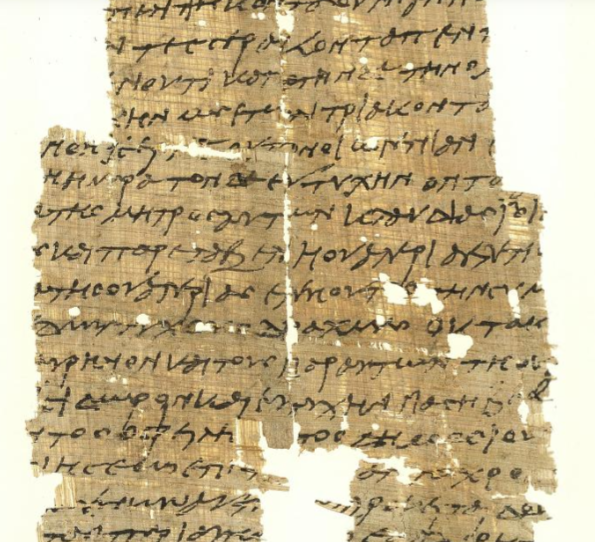
(Fragment of a Late Roman slave sale contract (p.mich.inv.4907), University of Michigan)
By James R. Burns, with thanks to Erin Thomas Dailey, Sheida Heydarishovir, Sofia Puchkova, and Justin Pigott.
This blog post is about parallel concepts of slave ownership; it has been made possible by the expertise of colleagues on the DoSSE project in different late antique societies.
For a succinct, contemporary expression of what it meant to be a slave in Merovingian Francia, it is hard to do better than this clause in a formulary of Angers for selling oneself into slavery:
whatever you want to do with me, may you have the power of doing, just like with your other slaves (mancipia), subject in all things, from this day onwards, by God’s favour.[1]
But where did this idea come from? Was it peculiarly ‘Frankish’ or ‘barbarian’ or ‘Germanic’? And what does it actually mean?
A similar proviso in a formulary for the sale of a household slave elaborates that the owner’s power to do what he wants included the ability to keep, sell, gift and exchange the slave. These formularies therefore bring the slave’s status as property to the fore. Indeed, as Alice Rio notes, identical phrases occur in other Merovingian formularies for the transfer of land, vineyards, and other estates.[2] The most intriguing of those formularies roots this concept of property in both Roman and Merovingian legal culture:
Roman law teaches, and the tradition of this place agrees, and royal power does not forbid, that every man should do what he wants with the property he owns at present.[3]
This appeal to Roman law is obviously very vague – even ‘decorative’.[4] And yet near-identical concepts of (slave) ownership can be found in slave sales from the Roman world, such as this third-century Syriac-language contract from Dura Europos:
from this day and in perpetuity, you, Tiro, the buyer and your heirs will have the right of disposal over this female slave that I have sold you, to acquire and to sell and to do with her whatever you wish.[5]
The same idea seems to be present in the Greek papyri that survive from Roman Egypt. A papyrus from 16/15 BC reads:
Eirenaios, the purchaser of the indicated little slave-girl, [… holds her and may use] her in whatever way he may choos[e].[6; added in update 11/12/2025].
Meanwhile, a mid sixth-century slave sale of two girls – so a near-contemporary to the time when the formulary collection of Angers seems to have originated – gives the buyer the power to:
drive them and to lead them to the slave-fate by you for ever, in whatever way you may want.[7]
Transcriptions and translations on the papyri.info database indicate that such clauses, where owners are ascribed the power to do what they want with their slaves, were present in Greek-language slave sales throughout the intervening period.[8] Although some of the readings offered by the modern editors of the papyri are conjectural – i.e., text proposed to fills the gaps left by holes in the papyri – they are lent support by the presence of similar expressions of ownership in papyri for the transfer of other types of property.[9] Aramaic and later Arabic sale documents also phrase ownership rights very similarly.[10; added in update 11/12/2025].
So it seems quite likely that this idea – that ownership of a slave meant doing with them what you please, in the sense of treating them like property – originated somewhere in the Mediterranean cultural milieu and reached the Frankish world through Roman slave sales, though reconstructing a direct process of transmission is hard to do given the patchy survival of documentary sources.
However, an almost identical phrase is also present in a Sogdian slave sale found in the Silk Road city of Turpan/Turfan, dating from 639 – around the conquest of the Gaochang kingdom by the Tang:
Accordingly, the monk Yansyan himself and his sons, grandsons, family, and descendants may at will hit her, abuse her, bind her, sell her off, pledge her, give and offer her as a gift, and do whatsoever they may wish to [do to her]. [They are entitled to treat her] just as a female slave inherited from their father or grandfather, or a female slave [who was] born in their house, born on their side (?), or born at home, or as permanent property purchased with drachm.[11]
Unlike the other slave sales discussed above, this one explicitly gives the owner the right to beat the slave – but it is probable that this was implicit for Roman and Merovingian slave owners anyway, given the bountiful evidence for the corporal punishment of slaves in these societies.
I do not know enough about the history of early medieval central and east Asia to state, with any confidence, that the idea someone could do what they wanted with their slave travelled out eastwards from the Roman Mediterranean. Perhaps this was just a common and obvious way of framing property and slavery to the point of occurring independently in multiple ancient societies. Perhaps the direction of travel could have gone the other way. Or perhaps older precedents underlie both the Sogdian and (post-)Roman contracts. Still, given the increasing tendency to emphasise the diversity both of slaveholding practices and early medieval societies generally, it is striking that people from Francia to China shared a way of conceptualising slave ownership.
Thank you for reading! There will be an extended discussion of these sources in my doctoral thesis.
References
[1] Formularies of Angers, no.2. My translation.
[2] Alice Rio, The formularies of Angers and Marculf: two Merovingian legal handbooks (Liverpool: Liverpool University Press, 2008), p. 50, n.112.
[3] Formularies of Angers, no.58. Translation from Rio, Formularies, p. 99.
[4] Alice Rio, Legal practice and the written word in the early Middle Ages: Frankish formulae, c. 500-1000 (Cambridge: Cambridge University Press, 2009)
[5] Cited and translated in Douglas M. Gropp, ‘The origin and development of the Aramaic šallīṭ clause’, Journal of Near Eastern Studies, 52, no.1 (1993), pp. 31–36 (33). See also David G. K. Taylor, ‘Seeing slaves in Syriac sources’, in Vittorio Berti and Muriel Debié, Le droit en monde syriaque, Études syriaques 18 (Paris: Geuthner, 2023), pp. 291–390 (316).
[6] p.stras.1.79 translated in Bezalel Porten et al., The Elephantine papyri in English: three millennia of cross-cultural continuity and change (Brill: Leiden, 1996), p. 427.
[7] p.cair.masp.1.67120, translated in Jakub Urbanik, ‘P. Cairo MASP. I 67120 recto and the liability for latent defects in the late antique slave sales or back to epaphe’, The Journal of Juristic Papyrology, 40 (2010), pp. 219–247 (223–224). See also Jonathan F. Healey, The Syriac legal documents of the 3rd century CE (Brill: Leiden, 2025), pp. 45, 140.
[8] For example, pylon.1.11_1; p.mich.15.707; p.bodl.1.44.
[9] p.wisc.2.59; p.lips.1.27.
[10] Aramaic: e.g., p.yadin.2 (97/98 CE), edited and translated in Yigael Yadin, Jonas C. Greenfield, Ada Yardeni, and Baruch A. Levine (eds.), The documents from the Bar Kokhba period in the cave of letters: Hebrew, Aramaic and Nabatean-Aramaic papyri (Jerusalem: Israel Exploration Society, 2002), p. 209. Healey, Syriac legal documents, p. 140. Arabic: chicago.apis.7797 (946 CE).
[11] Yoshida Yutaka (trans.), cited by Valerie Hansen, ‘New work on the Sogdians, the most important traders of the Silk Road, A.D. 500-1000’, T’oung Pao, 89, no.1 (2003), pp. 149–161 (160).